

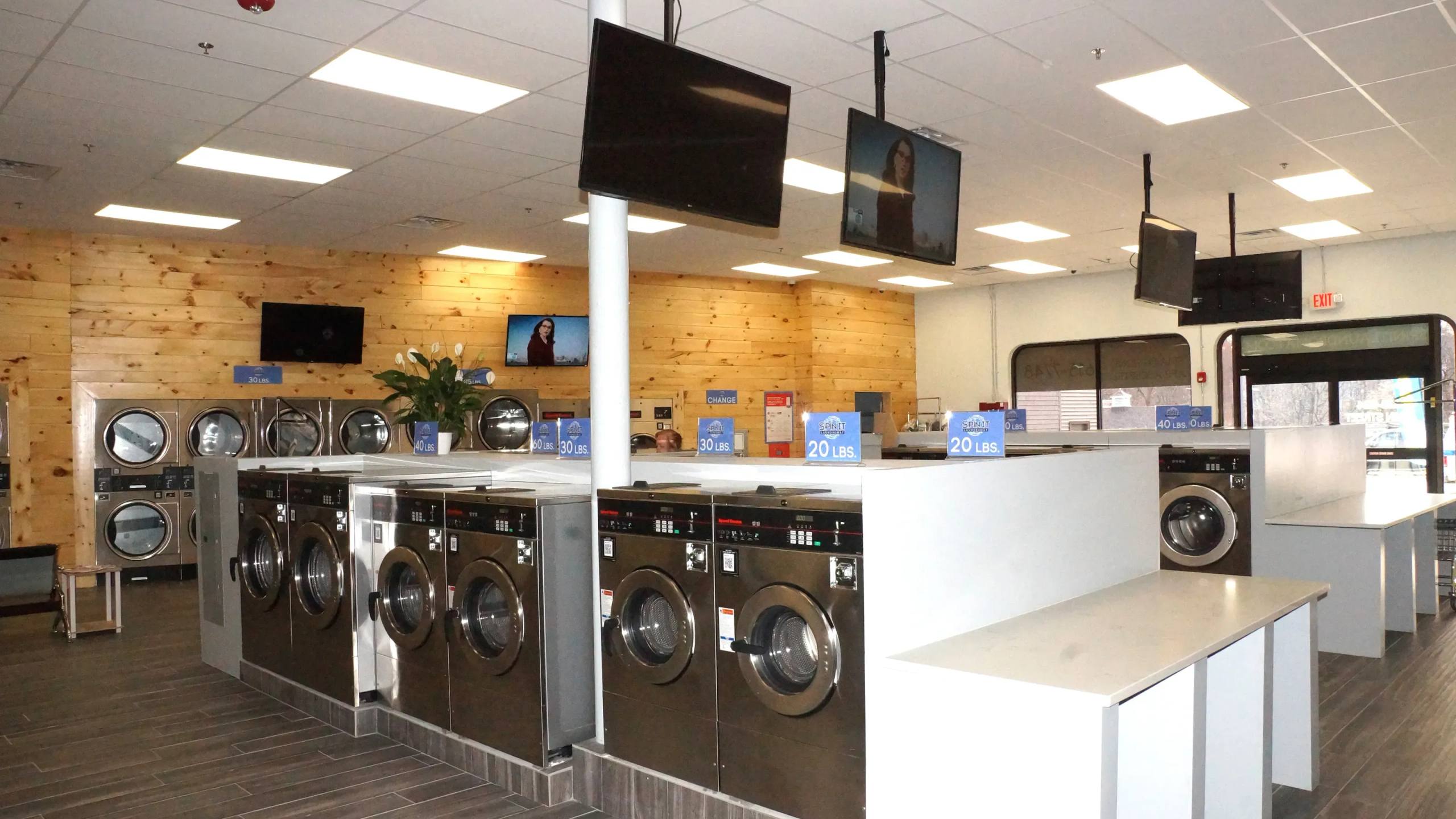
Pick the smallest washer your load fits in loosely, with room for everything to tumble. That one rule saves money on small loads and protects bulky items on big ones. At Spin It Laundromat in West Warwick, our Speed Queen washers come in 20, 30, 40, 60 and 100 lb sizes, so there's a right fit for almost anything you bring in.
The guide below explains what the pound rating means, what usually fits in each size and how to load a machine so everything comes out properly washed. Treat the examples as rules of thumb. Fabrics, fill and how tightly things are packed all make a difference.
What does the pound rating on a washer mean?
The number on a washer is its capacity in pounds of dry laundry. A 20 lb washer is built to handle about that much dry clothing in one cycle. It doesn't mean you should pack the drum to the top. Laundry needs space to lift and drop through the water, because that movement is what gets it clean.
Weight and bulk are also different things. Ten pounds of jeans takes up far less room than ten pounds of comforter. Bulky, light items fill a drum long before they reach its weight limit, so size up for anything puffy.
What fits in each washer size?
Each step up in size holds more, from a week of clothes in the smallest washer to a king comforter in the biggest. Here is a rough guide.
20 lb washer
Our smallest washers suit everyday loads. Think one person's clothes for a week, a set of sheets with pillowcases, or a batch of bath towels. It's also the right choice for keeping darks, whites or delicates apart without paying for a big machine.
30 lb washer
A 30 lb washer handles a larger mixed load, such as a couple's weekly laundry or a full set of towels plus sheets. It can also take a thin twin quilt or a throw blanket with room to move.
40 lb washer
This is a good size for a busy family load: kids' clothes, work clothes and towels together. It also suits a twin or full comforter, a few blankets, or a sleeping bag that needs space to rinse out.
60 lb washer
A 60 lb washer takes the kind of load that would fill two or three home washers. It works well for a queen comforter, a big pile of bedding after guests leave, or several weeks of laundry you have been putting off.
100 lb washer
Our 100 lb washers are the ones to use for the biggest jobs. A king comforter fits with room to tumble. So do large dog beds, heavy blankets and several sleeping bags after a camping trip. Short-term rental hosts and sports teams with lots of towels or uniforms can get a lot done in a single cycle.
How full should you load a washer?
Fill the drum about three-quarters of the way, loosely. As a quick check, you should be able to fit a flat hand between the top of the laundry and the drum. If you have to push the load down to close the door, move up a size or split it.
- Load items one at a time instead of dropping in a tight bundle, so they spread out evenly.
- Mix large and small pieces, like sheets with a few shirts, to keep the drum balanced.
- Wash one big bulky item on its own, or with a couple of small ones to balance it.
- Zip zippers and empty pockets before you load anything.
Overloading is a common reason clothes come out with soap streaks or stay smelly. Underloading is cheaper to fix: you just pay for more machine than you needed.
Is one big washer better than two small ones?
Often, yes, for big loads. Self-service prices at Spin It are set by machine size and listed at the store, so you can compare one large washer against two or three small ones before you start. One large machine also means one cycle to watch, one trip to the dryer and less time waiting.
Two small washers win when you need to keep loads apart, like work clothes from baby clothes, or whites from a new pair of dark jeans that might bleed color.
What dryer size do you need?
Our dryers come in 30, 45 and 75 lb sizes. The same rule applies: give the load room. Clothes dry faster and wrinkle less when they can tumble through the warm air. A packed dryer leaves damp spots in the middle, and you end up paying for extra time.
Bulky items need the most space. Put a comforter or a sleeping bag in a big dryer on its own, use low or medium heat, and pull it out to shake it every so often. Thick filling can feel dry on the outside while the middle is still wet, so squeeze the thickest part before you fold it.
Tips for a smooth laundromat visit
- Sort at home by color and fabric, so you know how many machines you need before you walk in.
- Bring your own detergent if you have a favorite. There are vending machines in the store, and the team at the counter can tell you what's in them.
- Read the care labels on bulky items before you leave home.
- Ask the team at the counter if you're not sure which washer to use.
- Use the folding tables to fold straight out of the dryer, so everything goes home neat.
Can someone else do the washing for you?
Yes. If you would rather skip the machines, drop your laundry off for wash and fold at $1.29/lb. We weigh it at the counter, then wash, dry and fold it. For laundry pickup and delivery, schedule a pickup online and pay $1.99/lb. Comforters cost $19.99 each with a pickup, and are priced by item at the counter.
Spin It Laundromat is at 824 Main St, West Warwick, RI 02893, at the corner of Main Street and Phenix Avenue, with off-street parking at the store. We're open 7 AM to 9 PM every day. Call (401) 615-7748 with any question about machine sizes.